Chip Density and Mat Friction: Key Factors for Steady Handling in Extended Home Poker Games
Written by Freya Hartmann · Sep 17, 2026
Chip Density and Mat Friction: Key Factors for Steady Handling in Extended Home Poker Games
Chip density directly influences how players lift, stack, and move pieces during long sessions, while mat friction determines resistance and slide control on the surface below. Researchers in materials engineering have documented that higher density chips, often weighing between 10 and 14 grams each, create greater downward force that interacts with surface textures to reduce unintended movement. Data from equipment testing labs shows this combination helps maintain stability when sessions extend beyond four hours, as players repeatedly handle stacks without excessive sliding or sticking.
Understanding Chip Density in Practice
Manufacturers produce chips using composite materials that range in specific gravity, which affects both weight distribution and tactile feedback. Studies on polymer blends indicate that denser cores paired with outer shells allow chips to sit firmly on mats without requiring extra pressure during shuffles or bets. Observers note that in community settings, sets with consistent density across colors help players distinguish values quickly, reducing errors in multi-hour play where fatigue can set in. One equipment analysis revealed that variations as small as 0.5 grams per chip alter perceived handling when friction levels on the mat remain constant.
Mat Friction and Surface Interactions
Playing mats typically feature felt or synthetic weaves with measurable coefficients of friction, ranging from 0.3 for smoother finishes to 0.6 for more textured options. These values determine how chips respond to lateral forces during pushes or gathers. Research indicates that mats with moderate friction levels pair effectively with mid-density chips to prevent both excessive slipping and excessive drag. In September 2026, industry reports from the Commonwealth Scientific and Industrial Research Organisation highlighted material pairings that support sustained use in recreational environments. Such pairings allow stacks to remain intact even after repeated handling cycles.
Combined Effects Over Time
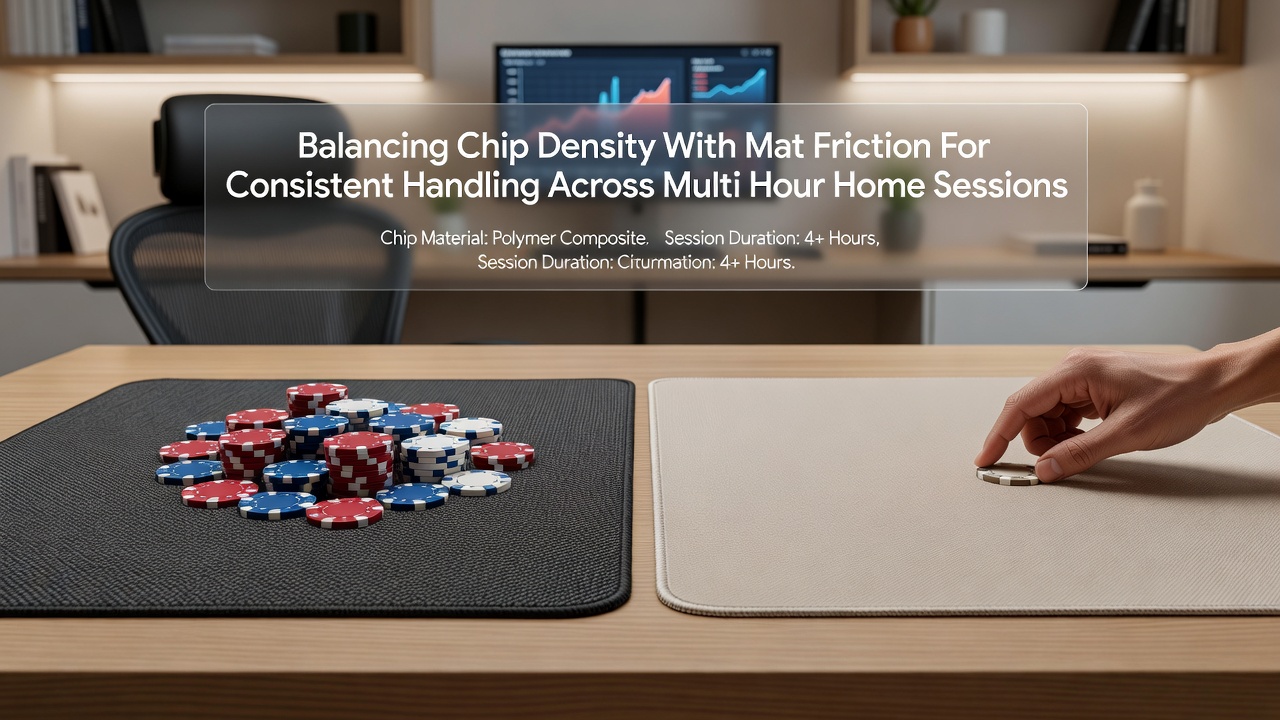
When density and friction align properly, players experience fewer disruptions during extended games. Evidence from surface testing shows that mismatched combinations lead to chips that either slide too freely or catch on fibers, interrupting flow. Those who track usage patterns across regional gaming groups report that balanced setups support up to eight continuous hours with minimal adjustment needs. Figures from durability assessments reveal that friction coefficients above 0.5 help anchor denser chips, while lower densities benefit from slightly reduced surface resistance to avoid bunching.
Practical Considerations for Home Configurations
Home users often select components based on observed performance rather than isolated specifications. Data collected by gaming accessory suppliers shows that testing small samples under session-like conditions predicts long-term consistency better than manufacturer claims alone. Experts have observed that seasonal humidity changes can alter mat friction by up to 15 percent, which then requires density adjustments in chip sets to restore balance. In regions with varying climates, such adaptations keep handling predictable across different times of year.
Equipment compatibility lists from trade associations further detail how chip edge designs complement mat weaves. Smoother chip perimeters reduce wear on higher-friction surfaces, extending mat life while preserving stack integrity. Those monitoring community trends note increased interest in modular mats that allow friction zones to match specific chip weights without full replacement.
Conclusion
Balancing chip density with mat friction supports consistent handling by aligning physical properties with session demands. Research continues to refine these pairings through standardized testing, providing home players with measurable options for sustained performance.